What changed
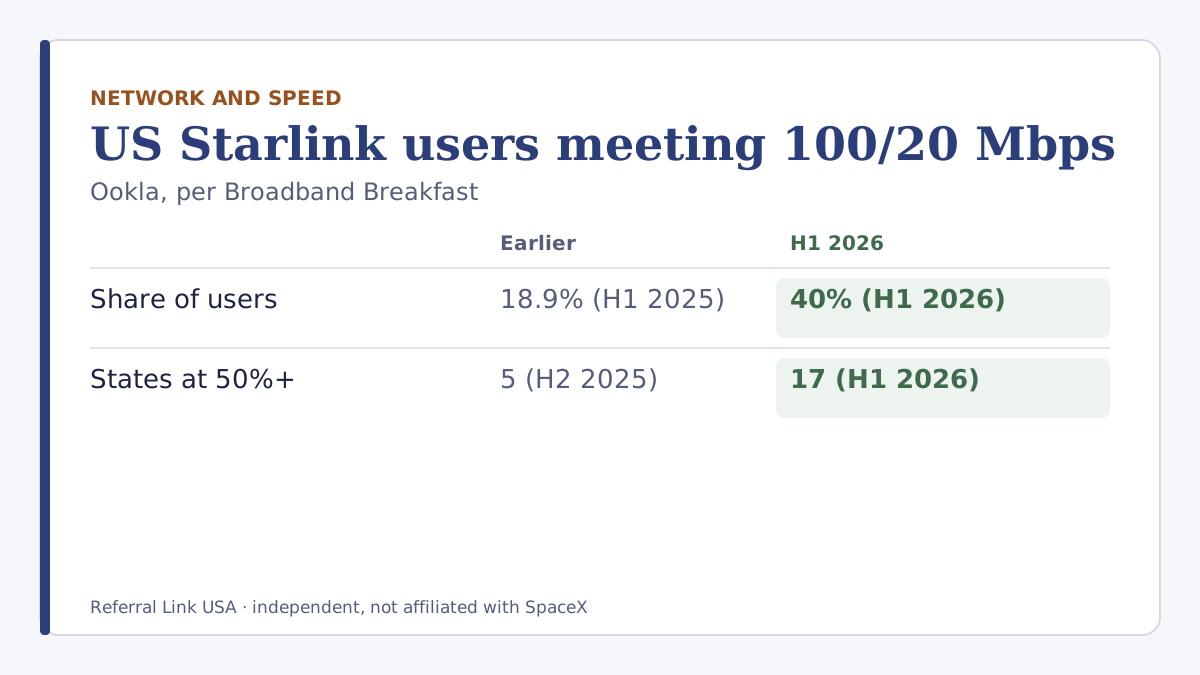
Ookla’s U.S. Broadband Performance Report for the first half of 2026, as reported by Broadband Breakfast on Sep 15, 2026, found that roughly twice as many US Starlink Speedtest users reached the FCC’s 100/20 Mbps broadband benchmark as a year earlier: about 40% in H1 2026, against 18.9% in H1 2025.
The number of states where at least half of Starlink users met the benchmark rose to 17, from 5 in the second half of 2025. South Dakota led at 58.2%, followed by Nebraska at about 57%. Larger states lagged: the report puts Texas at 31.4%, Florida at 30.9% and California at 42.8%. The same coverage notes that Starlink still trails wired broadband: “Ookla found that 46 states and Washington, D.C., had at least 60 percent of fixed broadband Speedtest users reaching 100/20 Mbps.”
When
The report covers Speedtest results from January to June 2026. We date this post to Broadband Breakfast’s article of Sep 15, 2026, because we could not open Ookla’s own page to confirm its publication day; treat the date as approximate.
Who is affected
People deciding whether Starlink will be fast enough at home, and owners whose friends ask “is it actually good?” before using a referral link. Nothing about plans, prices or the referral program changes.
What it means for you
If you refer friends, this is the kind of independent number worth pointing to instead of a promise. It describes a share of users meeting a threshold, not the speed any one home will get. Results depend heavily on location: the gap between South Dakota and Florida in the report is close to 30 points.
A referral can’t fix a bad fit. The new customer only gets the free month if they stay on a high-speed plan for two full billing cycles, and the referrer is only paid if they do. A friend in an area where speeds are weak is better served by checking first than by ordering and cancelling inside the return window.
What to do now
Before sharing your link, suggest your friend look up their state in Ookla’s report or ask neighbours who already use Starlink. If they order and it disappoints, Starlink’s 30-day hardware return window still applies to kits bought on starlink.com.
What stays the same
Speed figures don’t change the program: the reward, the free month, the two-billing-cycle stay and the eligible plans are unchanged.
What we don’t know yet
Ookla’s median download and upload speeds for H1 2026 weren’t in the coverage we could read, and Speedtest data comes from users who chose to run a test, so it is not a census. We also don’t know how much of the gain comes from new satellites versus fewer users per cell in a given area.
How to check it yourself
Ookla publishes its broadband reports on its own website; look for the U.S. Broadband Performance Report for H1 2026 and find your state. Broadband Breakfast’s summary of Sep 15, 2026 gives the headline figures we quote. If you want a number for one home rather than a state, a neighbour’s Speedtest results on Starlink at different times of day will tell you more than any average. Keep in mind that Speedtest data comes from people who chose to run a test.