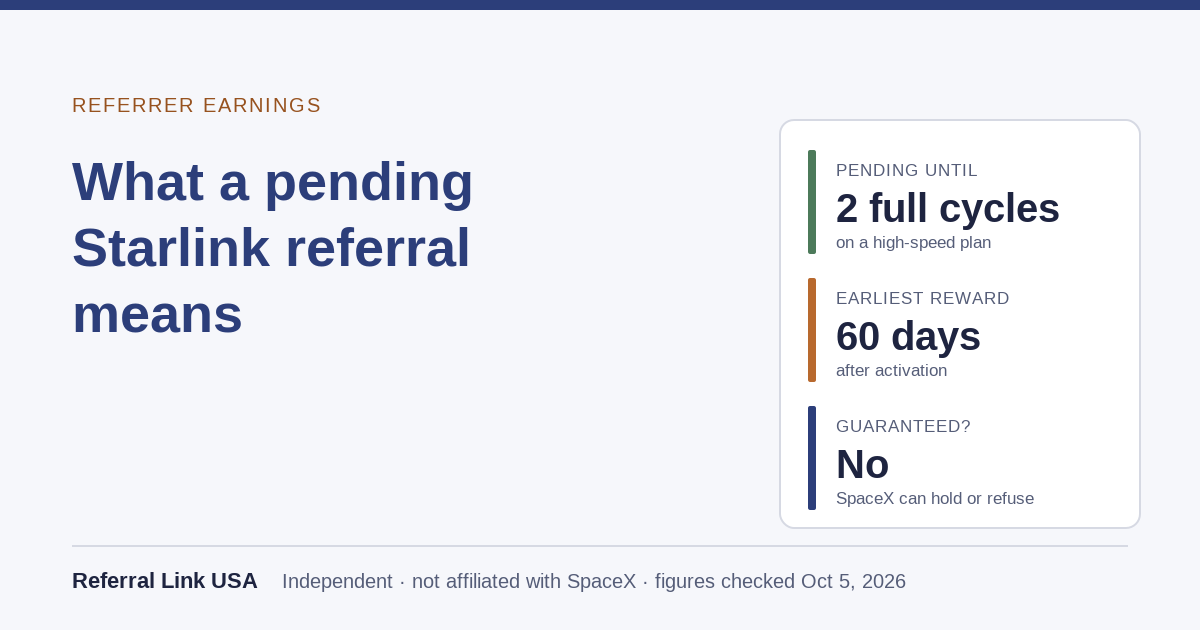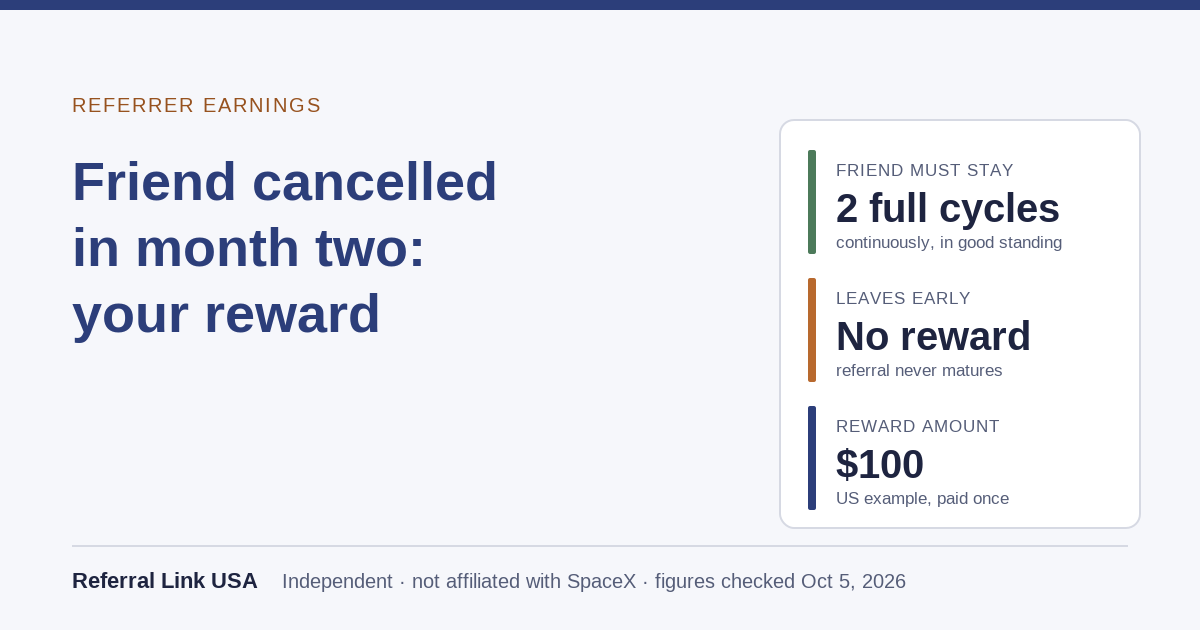
If the friend you referred cancels before finishing two full monthly billing cycles, you don’t get the referral reward. Their referral stays “pending” and never matures into an eligible one, and only eligible referrals pay. If they cancel after those two cycles, the referral has already matured and your reward is paid. The date they leave, measured from the day they activated, decides everything, and since the terms republished on Oct 7, 2026, it very likely decides their reward too.
Below: the rule, the three timing cases with real dates, what your friend gets, and how to handle it like a decent person.
The rule
The minimum stay sits in the terms’ list of conditions for the new customer:
“The Referred Subscriber must maintain continuously subscribed and in good standing for two full monthly billing cycles in order for a Pending Referral to mature to an Eligible Referral.”
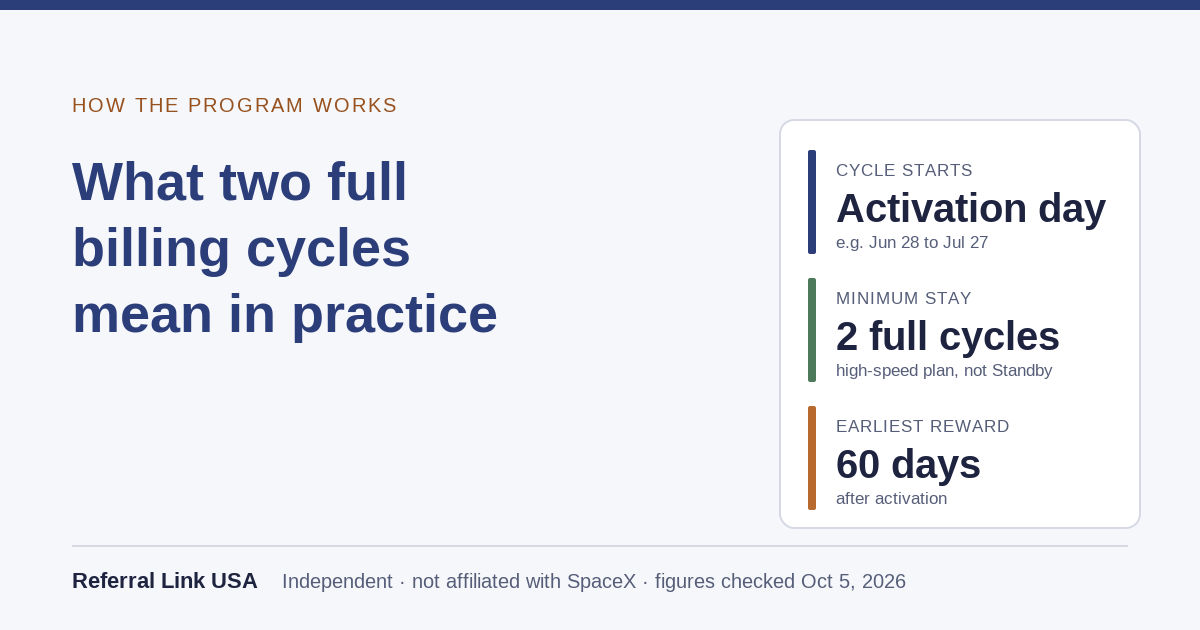
The help center’s version for the sender is shorter: rewards are issued after the friend has subscribed for two months, and rewards are issued as soon as 60 days after the friend activates.
There’s no partial credit for one month. Each successful referral pays once, and it’s paid only for an eligible referral.
What changed for your friend on Oct 7, 2026
For the record, until the Oct 7, 2026 terms, the new customer got one free month of service on their plan, applied to the second monthly bill. That arrived about a month before your reward, so a friend who left in month two often kept it while you got nothing.
Today your friend gets the same reward as the person who shared the link: $100 in the US (shown in the Starlink account), as service credit or cash where the account offers it. In other words, the new customer and the person who shared the link receive the same reward, and it is issued after two months subscribed (as soon as about 60 days after activation). The amount is set by Starlink and shown in the account; in the US it is $100, and Starlink can change it. Your friend the new customer pays for the first month as normal.
So the two rewards now sit on the same clock. A friend who leaves before two months is very likely leaving their own $100 behind as well as yours.
The three timing cases
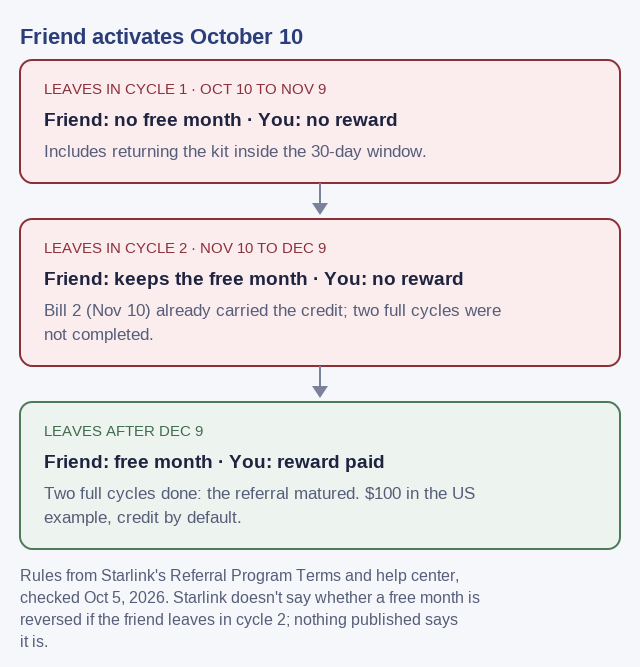
Starlink’s billing help page says a billing cycle starts on the day the kit is first activated. Take a friend who activates on October 10:
| Friend leaves | Cycle | Their reward | Your reward |
|---|---|---|---|
| Before Nov 10 (or returns the kit) | Cycle 1 | No | No |
| Nov 10 to Dec 9 | Cycle 2 | Most likely no (our reading) | No |
| After Dec 9 | Cycle 3 or later | Yes, as soon as about Dec 9 | Yes, as soon as about Dec 9 |
Case 1: they leave in the first cycle
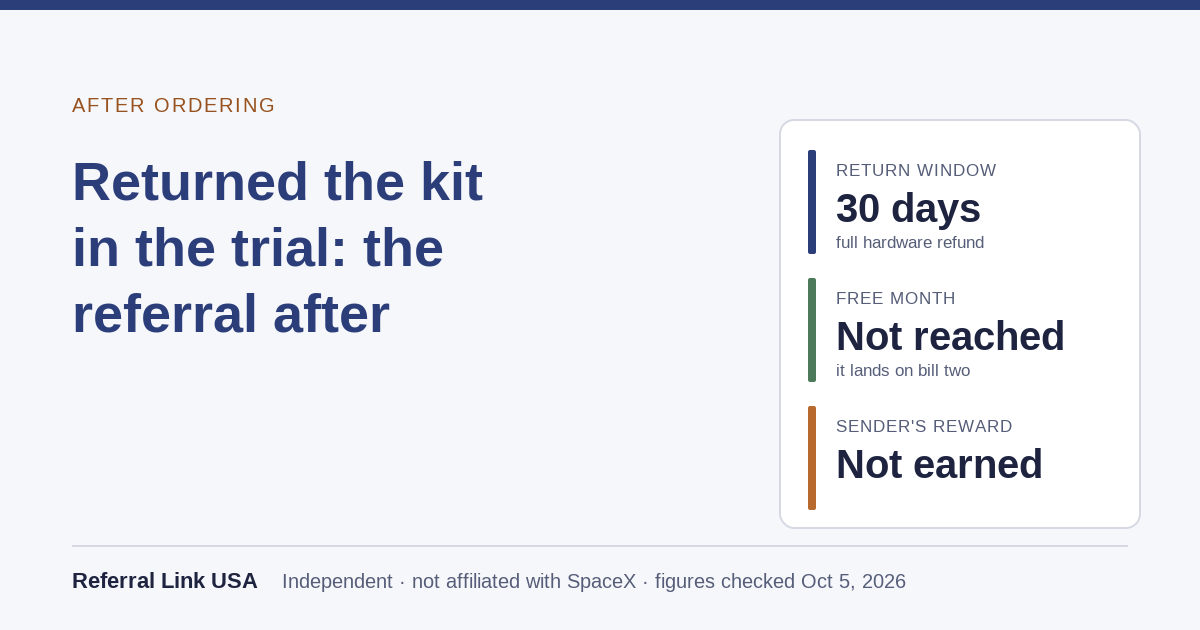
They never get near two months, so neither of you gets a reward. This includes returning the kit: Starlink’s return page says that to return a kit you have to cancel your subscription, and a kit cancelled within the 30-day return period gets a full hardware refund. Returned the kit during the trial covers that case in detail.
Case 2: they leave in the second cycle
Under the old terms this was the case that stung: your friend had already had their free month on bill two, and you got nothing. Now it’s even on both sides. Their reward is issued after two months subscribed, and the minimum stay doesn’t end until December 9 in the example. A friend who leaves in late November has paid for two months and, in our reading, gets no reward. Starlink doesn’t publish a sentence about this exact case for the new customer, which is why we label it ours.
If your friend is thinking of leaving in cycle two, it’s fair to mention, once, that their own reward is close. It’s not fair to make it a sales pitch.
Case 3: they leave after two full cycles
The referral matured on December 10. Your reward is paid as normal, as credit unless you switched to cash, and their later cancellation doesn’t touch it. Your friend’s reward is issued on the same timeline, and each person's cash-or-credit choice is their own; the referrer's choice doesn't change the new customer's reward. Starlink’s help center says that with service credit, the reward is applied to the account and deducted from the next invoice.
One caveat: the terms also require the new customer to be actually uses the service and intends to keep it; SpaceX compares retention against the national average. A friend who stays exactly two cycles and leaves is within the wording, but it’s the kind of pattern that review is there to spot. One genuine change of mind isn’t a pattern; a string of short stays from the same link might be. And a reward can be limited, delayed or revoked, even after it's issued, for fraud, abuse or a terms violation.
What about Standby instead of cancelling?
If your friend pauses with Standby during the first two cycles rather than cancelling, the effect on your referral is the same. The new customer stays on a high-speed plan (not Standby) for two full monthly billing cycles. Standby is not a high-speed plan. Two full billing cycles shows why pausing in cycle two breaks the count.
How you’d find out
Starlink doesn’t publish a “your referral was cancelled” notice. What the help center describes is an email when someone orders through your link and a Referrals area where you can track successful referrals and rewards. So you might only notice when the expected date passes with nothing issued. If that happens and you don’t know why, work through stuck pending: what to check before contacting support.
Don’t ask your friend for their account details to check. The terms bar referrers from handling a prospect’s personal data: don't collect a prospect's personal data; share only the link and send them to starlink.com. If they tell you they cancelled, that’s your answer.
They want to come back later
They can come back as a customer, but not with a referral. The help center says existing and returning customers are not eligible. A friend who cancelled in month two and reorders next year pays the normal price, gets no reward, and your link can’t earn anything from it. The never-subscribed rule covers former customers in full.
Handling it with your friend
The honest position is simple: it’s their service and their money. The referral program pays you for introducing a customer who stays; it doesn’t make you their account manager. The terms say the referrer's role is limited to sharing the link; all quoting and billing happens between SpaceX and the customer.
What’s fine:
- Explaining how it works if they ask before ordering. “You pay month one as normal. If you stay at least two full billing cycles, we each get a reward, $100 in the US right now. Don’t keep it for my sake.”
- Answering questions about setup or billing with “Starlink support can see your account; I can’t.”
What to avoid:
- Pressuring them to stay past the point they want to, including by leaning on their own reward.
- Offering to cover their bill for the minimum period. Paying someone to stay so you can collect a reward drifts toward the “ways around the eligibility rules” the terms ban: no extra accounts or other ways around the eligibility rules. It also undercuts the “genuine intent to remain subscribed” condition.
- Asking them to switch to Standby instead of cancelling “until the referral clears”. It doesn’t clear on Standby anyway.
When it might not be their choice
Sometimes the exit isn’t voluntary: the dish doesn’t get a clear view of the sky at their home, service isn’t what they needed, or money gets tight. That last case connects to another rule. The terms say the new customer is not experiencing financial hardship, domestic or family violence, or another vulnerability, and the sharing rules forbid targeting vulnerable people. If a friend is under financial pressure, the right thing is to tell them to cancel if they need to, and not to have encouraged the sign-up in the first place.
What each case is worth, in numbers
Using Starlink’s US reward example and a $55 monthly price (the top Residential 100 Mbps level, $44–$55/mo, depending on the address; your address may price lower), here’s what’s at stake in each case:
| Friend leaves | Friend paid for service | Friend’s reward | Your reward |
|---|---|---|---|
| In cycle 1 (no return) | Month one, $55 | None | None |
| In cycle 2 | Months one and two, $110 | Most likely none | None |
| After cycle 2 | Every month, as normal | $100 | $100 |
Two things stand out. Under today’s terms the new customer’s reward is a flat $100, not tied to the plan price, so it’s the same on any eligible plan. And your reward isn’t a share of anything they paid: it’s a separate incentive from SpaceX, paid only for a customer who stays. Prices at their address can differ; checkout shows the real figure.
If it keeps happening
One friend leaving early is ordinary. If several people you refer leave inside two cycles, it’s worth asking why, because the terms give SpaceX room to look at it. The new customer has to be a genuine, active user, and you certify every referral: by submitting a referral you certify it meets every eligibility rule. Repeated short stays can look like the pattern the sharing rules are written to stop, even when every person acted in good faith.
The fix is in how the link reaches people. Give it to people who asked for it, who have checked that Starlink suits their location and budget, and who would order anyway. The program explainer is a good thing to point them to first, so they know they pay for the kit and every month, and that their reward only comes after two months. If they still want it, the referral is far more likely to mature.
Common mistakes
- Assuming one month earns half a reward. There are no partial rewards, on either side.
- Counting from the order date. Cycles start at activation, so a friend who ordered in September and activated October 10 isn’t done until December 9.
- Telling friends “month two is free”. That was the deal until Oct 7, 2026. Today it’s a $100 reward after two months.
- Pausing your own plan while chasing it. If you go to Standby, all your other pending referrals are cancelled too.
- Treating a second order as a fresh referral. A returning customer can’t use a link.
What we don’t know
As of our Oct 9, 2026 check, Starlink doesn’t state:
- Whether the sender is notified when a pending referral is cancelled.
- Whether a cancellation scheduled during cycle two, effective at its end, counts as completing two full cycles.
- In so many words, what happens to the new customer’s reward if they leave in cycle two. Our reading is that it’s never issued.
What to do next
- Want to see where each referral stands? What a pending referral means explains the stages and what protects them.
- Thinking about your own plan? Read pausing or cancelling your own plan before you change anything.
- Need a term defined? The glossary explains pending and eligible referrals.
- Want the owner’s view in one place? The owner’s guide covers what earns the reward and what cancels it, and the sharing rules cover what to say and not say to friends.